Commercial window coverings
Offices, salons, waiting rooms, short-term rentals and small retail. The same fabrics and the same pair of hands, applied to a different problem.
A business is buying a room that works, not a room that looks a certain way, and the two lead to different fabrics. Below is what actually changes, and what we need to know before anyone can put a number on it.
One we did
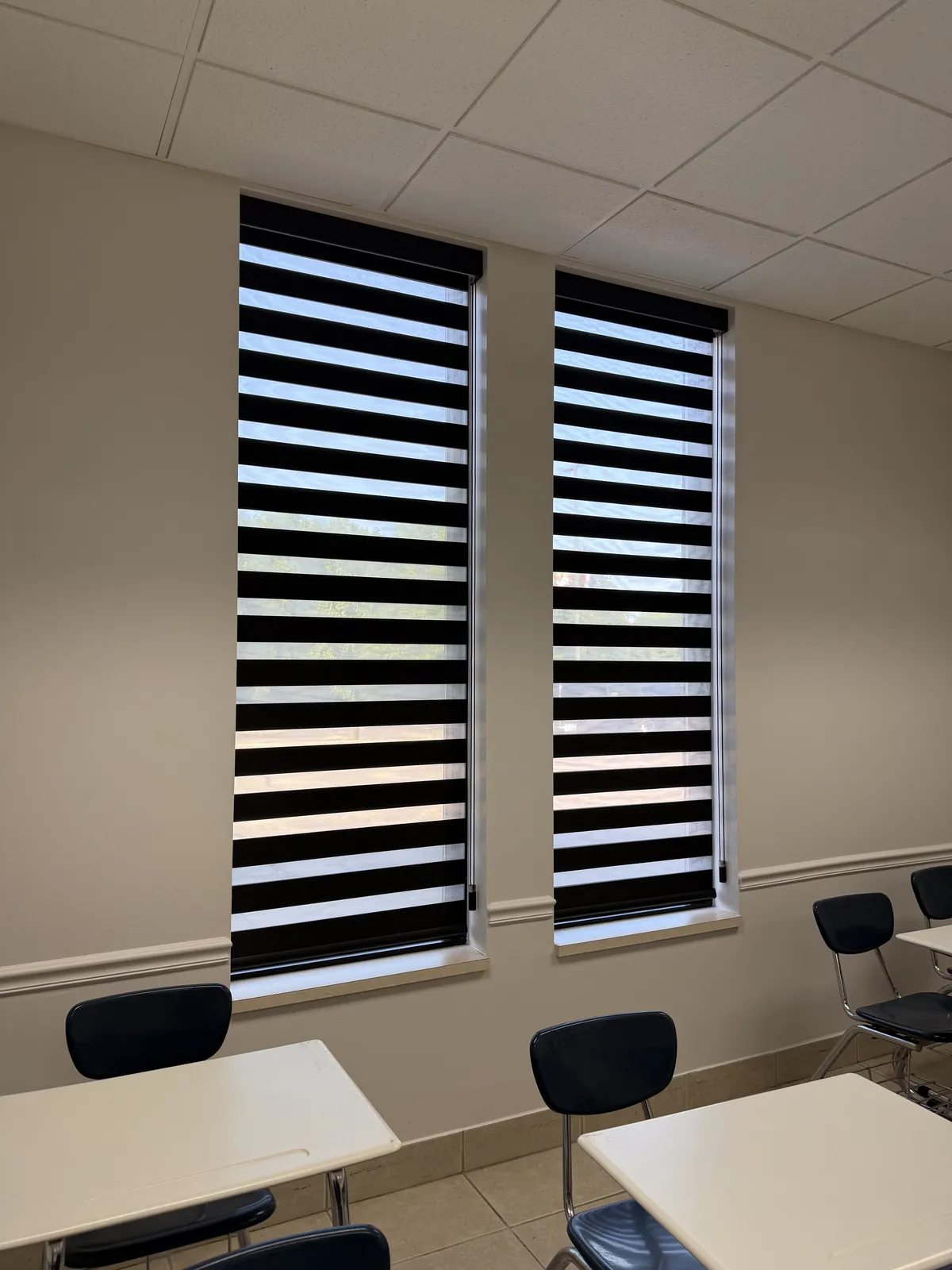
Dark zebra shades in a teaching room
Two tall openings on one wall, with the light landing straight across the desks. A dark cloth takes the glare out at desk height while the sheer bands stay lined up, so the room keeps its daylight and its view rather than trading both for a dark room.
Every photograph on this site is a job we measured and installed ourselves. None of it is manufacturer stock.
What changes
Five things a business decides differently
Not a different trade, a different set of constraints. These are the ones that come up on nearly every commercial measure, and the ones worth having an answer to before you start looking at fabric.
- 01
The problem is usually glare, not privacy
Almost nobody in a working room is worried about being seen from the street. They are worried about a screen they cannot read at three in the afternoon. That points at a screen fabric chosen for how much light it passes rather than at the darkest cloth in the book, because a dark room fixes the glare by removing the reason people liked the room.
- 02
Cords are a different question where the public can reach them
A house gets to weigh cordless against cost. A room that strangers and other people's children walk through does not really have the choice. Cordless lift and motorised both remove the hanging cord completely, and that decides the product before the fabric does.
- 03
One elevation has to match itself
From outside, a building reads as one thing, and a run of windows where two are a slightly different white is the first thing anyone notices. Ordering the run together keeps it on one fabric, and specifying the same drawn height keeps it that way in use. It is the cheapest thing on this list to get right and the most expensive to fix later.
- 04
Wide runs and windows nobody can reach
Fabric runs to a 300 cm finished width, roughly 118 inches. Anything wider splits across a shared headrail so it still reads as one treatment rather than as two blinds that happen to be next to each other. A single motor can drive several linked shades, which is how a long run lands on exactly the same line at the same moment instead of approximately.
- 05
Often it is replacing something that already failed
Snapped cords, fabric gone brittle on the south side, three different whites across one wall because it was patched twice, a motor nobody can get parts for. That is a different job from an empty fit-out and it gets scoped differently, so it is worth saying which one you have. Existing roller and zebra shades in good condition can often be motorised rather than replaced.
What usually goes in
Four of the eight, most of the time
Every product on the site can go into a commercial space and the fabric books come out either way. These are the four that answer the constraints above most often.
Roller Shades
Solar screen fabric. Cuts the glare and the heat, keeps the view and the daylight.
Zebra Shades
Glare control you can tune through the day without losing the window.
Aluminium Venetian Blinds
Thin slats, 180° tilt, wipes clean. Holds up where a fabric would not.
Motorised Blinds & Shades
Atriums, stairwells and long runs. Linked shades, or scheduled against the afternoon sun.
Before we can quote
Four things, and a call settles all of them
A multi-window job is quicker to talk through than to type, and the measure is free either way. Based in Metro Detroit, Michigan, and we travel for the right job.
- How many openings, and how many walls or elevations they sit on
- Which way the windows that cause the problem face
- Whether the space is occupied or still a fit-out
- What is up there now, if anything, and what went wrong with it
Walk us round it
We come out, measure every opening and tell you what the room actually needs, including where it needs less than you were expecting. Free, and nothing is booked by asking.